
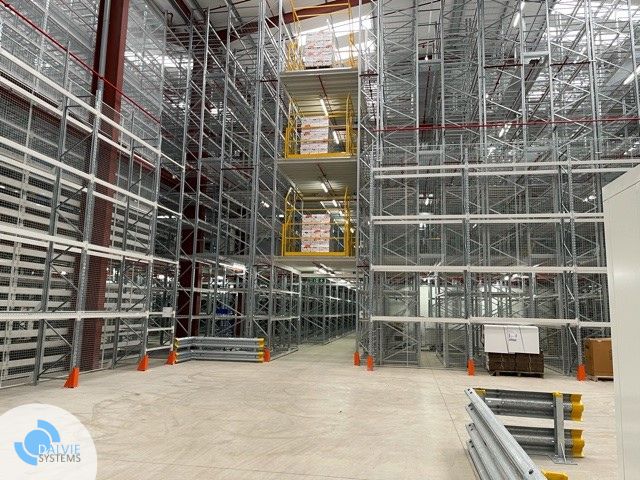
Most warehouses that install double deep pallet racking report a 40 to 60 per cent increase in pallet positions on the same floor footprint. Yet fewer than one in five operations directors across the West Midlands has formally evaluated this system against their current layout. That gap is not a matter of ignorance. It is a matter of assumption, specifically the assumption that double deep racking belongs to large-scale distribution centres rather than medium-sized manufacturing and logistics operations.
That assumption is costing businesses real capacity at precisely the wrong moment. With Q3 2026 stock builds now underway ahead of the autumn retail peak, operations directors are once again absorbing overflow costs, booking temporary offsite storage, and watching their storage density figures remain flat. The fix, in many cases, is already sitting within the building envelope they occupy.
Double deep racking places two pallet loads in series, one behind the other, on each level of a bay. Rather than accessing each pallet from a single aisle, a reach truck fitted with a pantograph attachment extends to retrieve the rear pallet without the truck itself needing to enter the racking structure.
This is a meaningful distinction from wide aisle pallet racking, which trades storage density for full individual pallet selectivity. Double deep accepts a modest reduction in selectivity in exchange for a substantially higher number of pallet positions within the same building envelope. The system operates on a last-in, first-out basis, which means it is best suited to high-volume SKUs where multiple pallets of the same product line are held simultaneously.
For operations managing seasonal peaks, promotional stock builds, or fast-moving consumer goods, that operational profile describes a significant proportion of their total inventory. The selectivity trade-off, in those cases, is largely theoretical rather than practical.
Three scenarios account for the majority of warehouses where double deep racking would deliver a measurable improvement in throughput and storage density, yet has never been formally evaluated.
The first is a warehouse that has grown its SKU count considerably over the past three to five years without reconfiguring its racking layout. High-volume product lines are occupying the same single-deep bays they always have, and the available aisle width is not being used productively. The pick face looks busy, but the space utilisation figures tell a different story.
The second is a site that explored mezzanine floor installation and ruled it out on cost or structural grounds, without then calculating whether a racking configuration change could resolve the capacity problem at a fraction of the price. A mezzanine is not always the right answer. For many operations, it is not even the second-best answer.
The third is a distribution operation managing predictable seasonal peaks, where temporary overflow storage at unpredictable commercial rates has become an accepted annual cost rather than a problem to solve permanently. In the West Midlands manufacturing and distribution corridor, where commercial property costs have risen sharply since 2024, that attitude is becoming increasingly expensive to maintain.
A fixed building with suboptimal storage configuration leaves an operations director with three expensive paths forward. The first is offsite overflow storage, which introduces variable costs, additional transport movements, and a fragmentation of stock visibility that creates its own operational headaches. The second is capital-intensive relocation, which carries disproportionate cost and disruption for a problem that may be entirely solvable within the existing site. The third is turning down business because fulfilment capacity cannot keep pace with order volume, which is the most damaging outcome of all and the hardest to quantify on a board report.
A configuration change that yields an additional 200 to 400 pallet positions from the same floor footprint represents a material business advantage. At typical West Midlands offsite storage rates, the payback period on a double deep installation is measurable in months rather than years for operations where overflow storage is a recurring cost.
There are also throughput implications that go beyond raw capacity. When high-volume SKUs are concentrated in a reconfigured double deep section, pick routes shorten, replenishment movements become more predictable, and the overall operational flow of the warehouse improves. This is not simply a space argument. It is an efficiency argument, and it is one that holds up under scrutiny from a finance director looking for demonstrable ROI on a capital expenditure proposal.
Operations directors frequently benchmark their warehouse layouts through informal walkthroughs of peer facilities, conversations at industry events, or site visits arranged through logistics networks. Double deep racking is less visually dramatic than a mezzanine floor or a drive-in racking structure, which means it rarely generates the kind of attention that prompts a formal evaluation.
There is also a persistent misconception about equipment requirements. Many operations directors assume that double deep requires specialist reach truck procurement that sits outside their current capital budget. In practice, a large proportion of West Midlands operators running modern reach truck fleets already have vehicles that are compatible with a pantograph attachment. The equipment barrier is often not a barrier at all, it is simply an assumption that has not been tested against the actual specifications of the trucks on site.
A third factor is that racking suppliers who work from a limited product range have no commercial incentive to recommend double deep when other configurations fill their order books equally well. This is a genuine problem in the market, and it is one that operations directors can only protect themselves against by working with a supplier who models multiple layout scenarios before making a recommendation.
The diagnostic process is straightforward if you know what to look for. Work through the following checks before commissioning any external survey.
Dalvie Systems carries out a full site survey and racking configuration analysis before any proposal is made. The process maps SKU velocity, existing equipment specifications, and floor load tolerances to establish whether double deep pallet racking is genuinely the right solution for a specific operation, or whether an alternative configuration would deliver better results.
That distinction matters. A supplier working from a single product bias will recommend the system they stock most readily, regardless of whether it is the best fit for your warehouse. The Dalvie team models multiple layout scenarios, so the operations director can compare storage density, throughput impact, equipment requirements, and total cost of installation side by side before committing to any capital expenditure. This is the kind of technical detail that supports a credible board presentation and removes the guesswork from a decision with a three to five year operational horizon.
The survey can also include racking inspection requirements under SEMA guidelines and HSE regulations, so any configuration proposal accounts for compliance obligations from day one rather than surfacing them as additional costs after installation. For operations that are already running a reach truck fleet, the assessment will confirm pantograph compatibility and flag any requirements for operator training before the new configuration goes live.
Double deep racking is not a compromise system. For the right product mix, it is a precision tool that can eliminate the need for offsite overflow storage, add years to the useful life of your current premises, and restructure throughput in ways that reduce pick times and labour costs simultaneously. The operations that get the most from it are those that install it ahead of a peak rather than in response to one.
With Q3 stock builds already in progress across the West Midlands, the window for a configuration change that is fully commissioned before October is narrowing. A site survey takes a single visit. A configuration comparison report follows within days. The decision to act or defer can be made on the basis of real data from your own warehouse rather than a generic sales brochure.
Contact Dalvie Systems to book a no-obligation site survey and receive a configuration comparison report specific to your warehouse. The survey covers double deep racking alongside any alternative configurations that your layout, product mix, and equipment fleet may support, so you make the right decision for your operation rather than the most obvious one.
