
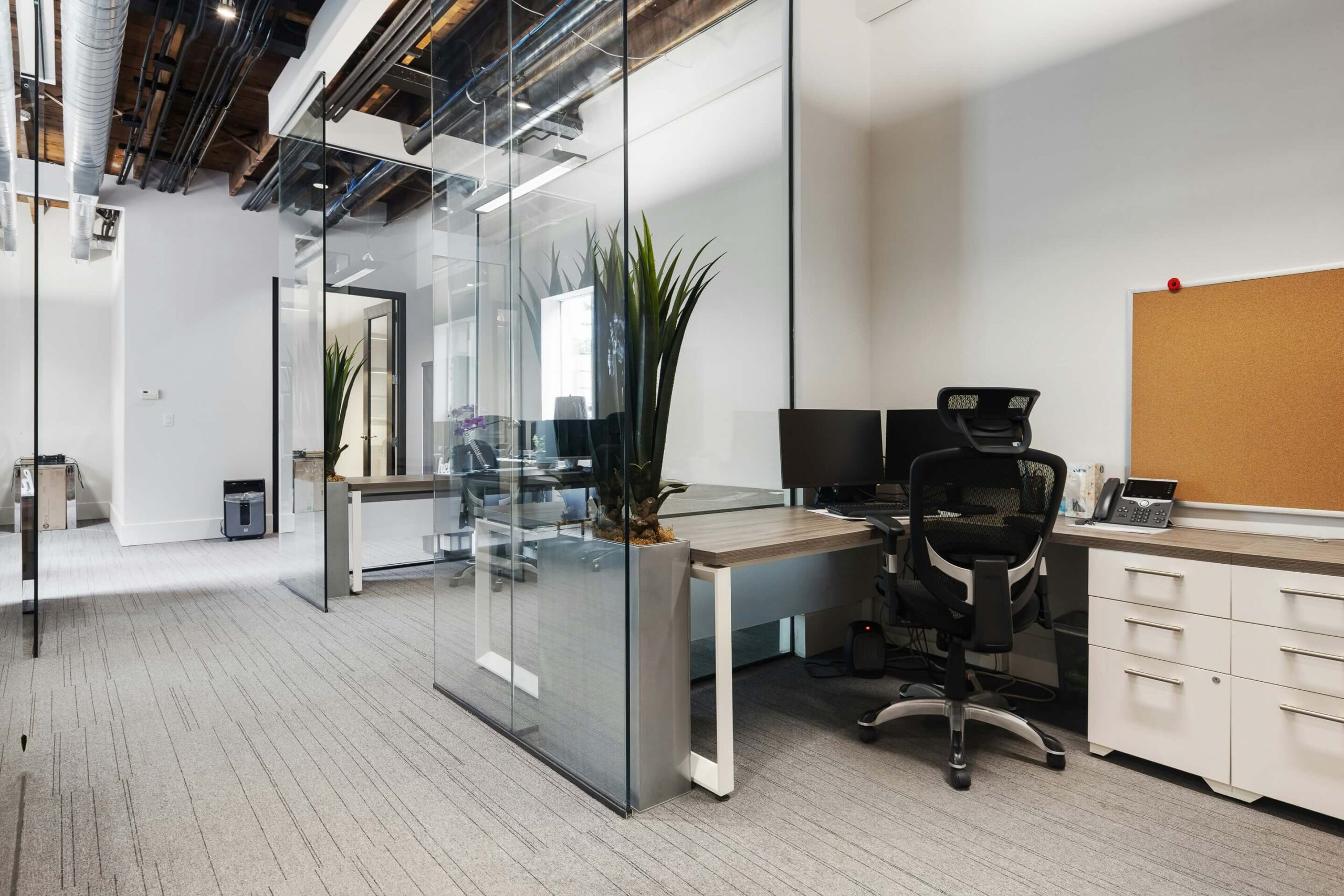
September carries a distinct “back-to-school” energy across the commercial world. Summer holidays wrap up, teams return to fuller capacity, and businesses refocus on finishing the calendar year strong.
But for most SMEs, hybrid working hasn’t gone away, it’s just quieter about it, and it’s changing what your office storage and layout actually need to do. Your office now has to work for a headcount that changes shape from one day to the next: a packed floor on Tuesday, a near-empty one on Friday, and a meeting room that’s either double-booked or dark depending on which day you ask.
That’s a different problem to “the office looks tired”, and it’s one most workplaces haven’t actually solved yet. Many businesses adapted to hybrid working in a hurry back when it first arrived, patching the immediate problem, enough desks, a rota, a video call login, without ever going back to ask whether the space itself still makes sense for how people actually use it now, more than a year on. September, with everyone back in the room, is the moment that gap becomes obvious. It’s also the best moment to fix it.
Here are four ways to make your space work harder this autumn.
Most office layouts were planned around everyone being in, every day. If your floor is still set up that way, you’re either short of desks on your busiest days or sitting on empty ones the rest of the week, and either way, the layout is working against you rather than for you. It’s a surprisingly common state for an office to be in, simply because nobody’s gone back to formally redesign the space since attendance patterns settled into their current shape.
The cost isn’t always obvious day to day, but it adds up: wasted square footage that could be doing something more useful, desks that sit empty while storage overflows elsewhere, and a floor plan that no longer reflects how or when your team actually works.
The Fix: Look at your actual attendance pattern over the last month, not the headcount on paper. Where the gap between “planned” and “actual” is biggest, that’s the space to reconfigure first, often by trading a bank of rarely-used fixed desks for more flexible collaboration or storage space. This doesn’t need to be a guessing game; even a simple two-week desk-usage count will show you exactly where the mismatch is.
Hybrid working means video calls didn’t stop when everyone came back to the office – they just moved into an open-plan floor that was never built for them. The result is the familiar scramble for a meeting room just to join a call without narrating it to the whole office, or the slightly awkward compromise of taking it at your desk and hoping nobody minds.
It’s a small daily friction, but it’s a constant one, and it’s exactly the kind of thing that quietly erodes how much people enjoy being in the office at all – which matters when the whole point of bringing teams back together is collaboration, not frustration.
The Fix: Screened breakout areas or partitioned quiet zones give people somewhere to step into without booking a full meeting room. It’s a smaller, cheaper intervention than most people assume, and it solves a daily irritation rather than an occasional one. Even converting one underused corner into a screened one- or two-person space can take the pressure off your formal meeting rooms significantly.
With a hybrid pattern, there’s rarely a week when the office is genuinely empty enough to close it for a full refit. A big-bang refurbishment either drags on around people still working, or forces a shutdown that lands badly with a team already juggling a changed routine, and either way, it’s disruption stacked on top of disruption at a time of year when most businesses can least afford it.
The Fix: Sequence the work zone by zone, breakout space first, then desks, then meeting areas, so each phase finishes before the next starts and nobody loses their space for more than a few days at a time. Autumn is a good window to start, since most of this can be wrapped up before the December wind-down, and a phased approach also spreads the cost across a few smaller pieces of work rather than one large one.
Physical records and compliance paperwork still pile up even in a digital-first business, and hybrid working makes it worse, when no one’s in the office every day, no one’s around consistently enough to file it, so it drifts into whatever cupboard or spare desk is nearest. Six months of that drift and it’s not a filing problem any more, it’s a floor-space problem.
The Fix: A proper office storage solution, centralised, labelled, and separate from working desk space, takes that paperwork off the floor for good and frees up space for people instead. It doesn’t need to be complicated; it needs an owner and a fixed home. Assign responsibility for the archive to someone specific, even if it’s a rotating duty, so it stays under control rather than becoming everyone’s problem and nobody’s job.
It would be easy to push all of this into the new year, when the “fresh start” instinct kicks in for most businesses anyway. But autumn has a real advantage: your team is back at closer to full attendance than at almost any other point in the calendar, which makes it the best window all year to actually observe how the space gets used, rather than guessing. Changes made now, based on real September attendance data, also have time to bed in and prove themselves before the traditional January reset, so when everyone does come back after Christmas, the office already works, instead of being the thing that needs fixing.
You don’t need a disruptive, all-at-once overhaul to make your workplace feel like it fits how your team actually works now. Targeted changes to zoning, storage and quiet space can transform day-to-day working life without shutting the office down to do it.
Looking to refresh your office storage or workspace layout for hybrid working this autumn? Contact Dalvie Systems to explore our range of commercial and office solutions.
